

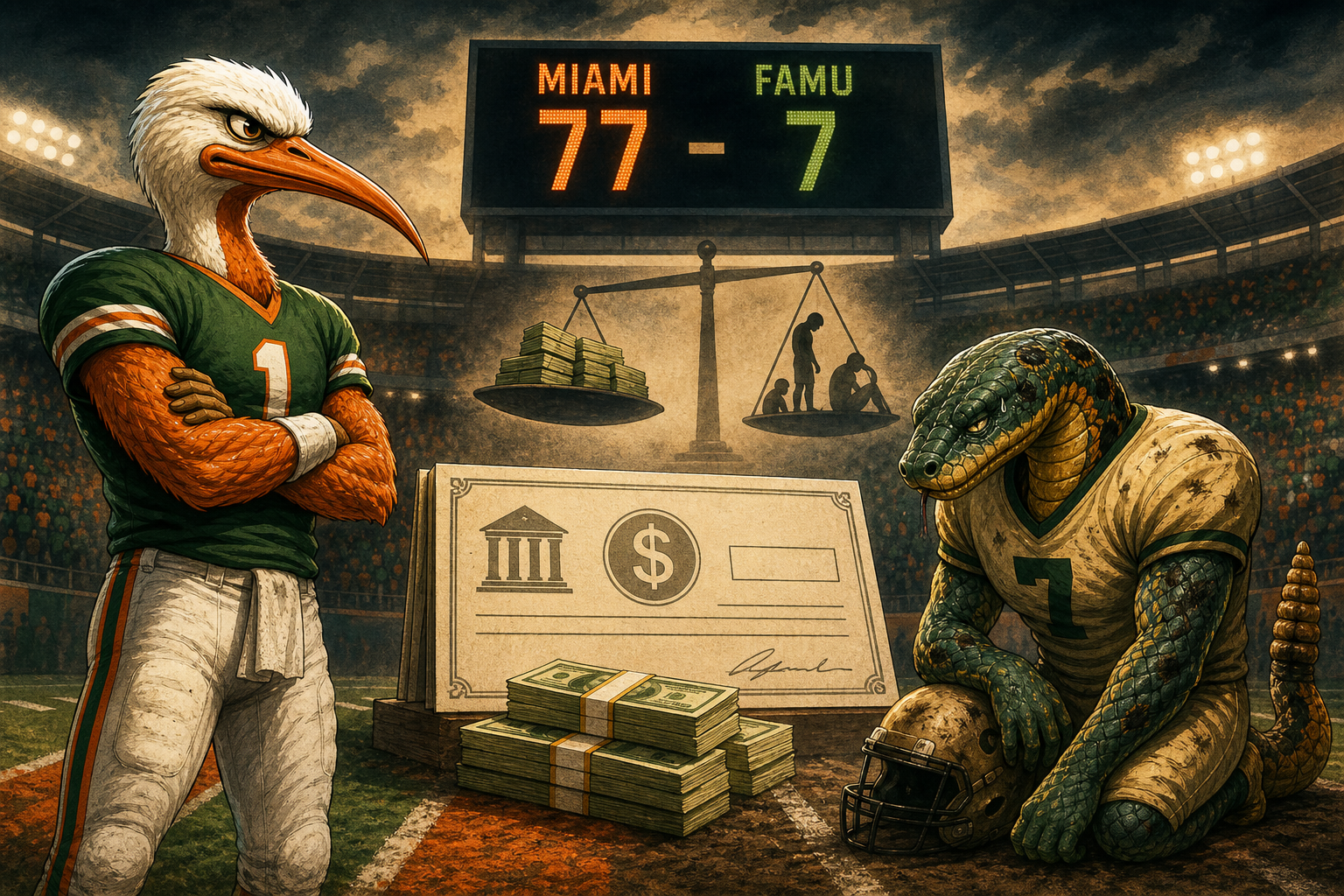
Ted’s Take: FAMU–Miami Was More Than a Blowout: The Cost of College Football’s Guarantee Games
What FAMU–Miami’s 77–7 Score Reveals About the Uncomfortable Economics of College Football
By Ted Taylor
The 77–7 result exposed the financial pressures that continue to push HBCU programs into unequal matchups with Power Four opponents.
Florida A&M did not accidentally end up on the field with Miami. The Rattlers agreed to play the game, and Miami agreed to host it. FAMU needed the money, Miami wanted the home game, and both institutions entered the arrangement knowing the competitive imbalance would be significant.
That is what makes the aftermath so complicated.
It is easy to criticize Miami after a 77–7 result and say the Hurricanes should have shown more restraint. It is also easy to criticize FAMU for accepting a matchup that was unlikely to be competitive. But the deeper question is this:
Who created a system in which an HBCU may have to accept a financially important but competitively dangerous game just to help make ends meet?
“FAMU set it in motion by asking to be prostituted. The woman wants to live the high life (FCS), and cannot afford it on her regular income so she has to go out and offer her body to make ends meet. And when the man accepts, he is accused of taking advantage of her.
FAMU accepted the arrangement because the money matters. The Rattlers are not operating with the same resources as a Power Four program. Guarantee games can help fund scholarships, staffing, travel, equipment and other athletic-department expenses. For an HBCU, that financial reality cannot simply be dismissed.
But the arrangement also exposes an uncomfortable imbalance. The wealthier program receives a home game, a manageable opponent and a likely victory. The smaller program receives a check—but also absorbs the physical risk, the competitive disadvantage and the public embarrassment of a lopsided score.
That is not a balanced business relationship. It is a system built around unequal bargaining power.
I have argued for years that many HBCUs should consider returning to Division II. The current structure has encouraged institutions and conferences to chase automatic bids, television exposure and postseason revenue, particularly in basketball. Yet the football programs often remain financially and competitively outmatched.


The result is a difficult contradiction: institutions want the visibility and revenue associated with Division I athletics, but many do not receive the resources necessary to compete consistently at that level.
The financial issue is even more troubling. HBCUs often do not receive the same level of support, investment or compensation available to predominantly white institutions. That disparity cannot be separated from the history of American higher education, where Black institutions and communities have repeatedly been asked to do more with less.
The language may be more polished today, but the underlying message can still sound familiar: the work is valuable, but it should cost less when a Black institution performs it.
That is where the discussion about guarantee games must go. It cannot stop at, “Miami should not have scored so many points,” or, “FAMU should not have scheduled the game.” Those arguments focus on the final score while avoiding the larger structure that produced it.
Should Power Four conferences follow the Big Ten’s reported approach of limiting games against FCS opponents? If so, that could reduce some mismatches—but it could also remove an important source of revenue for FCS programs. The answer cannot simply be to eliminate the games without providing smaller schools with another way to replace the money.
At the same time, HBCUs must be honest about their own role. Institutions cannot ask for sympathy after a blowout while continuing to schedule these games solely because the payout is attractive. If the arrangement repeatedly harms the players, damages the program’s image and offers little competitive value, then the decision deserves serious examination.
I have previously written about the possibility of HBCUs returning to Division II. In conversations with others, I have found general agreement that the central goal should be an enjoyable and sustainable college football experience. For many fans, that experience is more rewarding when their team has a realistic chance to win.
This is not an argument that HBCUs should lower their ambitions. It is an argument for aligning the level of competition with the resources available to the institution.
So, who is to blame for the FAMU–Miami blowout?
The responsibility is shared, but not equally.
FAMU accepted the game because its athletic department needs financial resources. Miami accepted the game because it benefited from the arrangement. The larger college football system created the conditions in which one institution could buy a victory while the other had to sell access to its players and program.
That does not make Miami solely responsible. It does mean the more powerful institution and the conferences that govern the sport have a greater obligation to ask whether the arrangement is fair.
A guarantee game may guarantee a payment. It does not guarantee competitive balance, player safety, institutional dignity or a meaningful game-day experience.
The lesson from FAMU–Miami should not be that one team was foolish and the other was cruel. The lesson should be that college football has normalized a business model in which the schools with the fewest resources often bear the greatest competitive cost.
And until that changes, the scoreboard will continue to tell only part of the story.


