

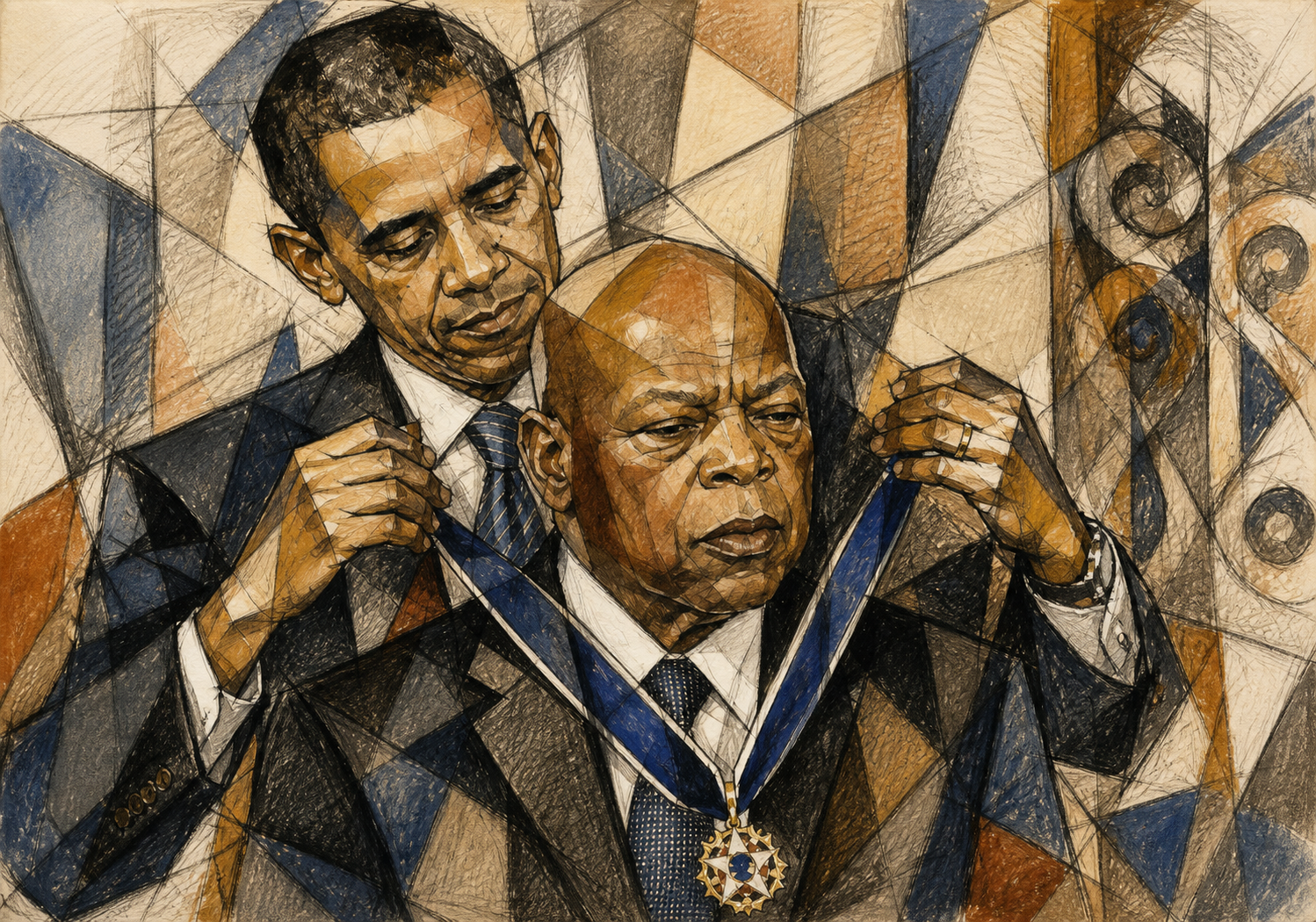
Let’s Talk: John Lewis and the Fight to Restore the Voting Rights Act
By Judith Williams
The federal legislation bearing John Lewis’ name—the John R. Lewis Voting Rights Advancement Act—was designed to restore and strengthen key protections of the Voting Rights Act of 1965.
The original 2021 legislation was introduced as H.R. 4. It passed the U.S. House of Representatives in August 2021 but stalled in the Senate. In the 119th Congress, the legislation was reintroduced in the House as H.R. 14 on March 5, 2025, and in the Senate as S. 2523 on July 29, 2025. Both bills were referred to their respective Judiciary Committees. (CONGRESS)
The proposed legislation responds in part to the Supreme Court’s June 25, 2013, decision in Shelby County v. Holder. In that case, the Court struck down the coverage formula used to determine which states and local jurisdictions had to obtain federal approval before changing their voting laws or procedures. That decision effectively suspended the Voting Rights Act’s preclearance system until Congress adopted a new formula.
The debate returned to the national spotlight following the Supreme Court’s April 29, 2026, decision in Louisiana v. Callais. The case involved Louisiana’s congressional redistricting plan and the relationship between race, politics, and Section 2 of the Voting Rights Act.
The Court ruled that race and politics must be separated when courts evaluate certain racial-gerrymandering claims. Supporters of the decision argue that drawing districts primarily to achieve a particular racial composition can improperly classify voters by race. Voting-rights advocates, including the Campaign Legal Center, warn that the ruling could make it more difficult to challenge maps that dilute the voting strength of racial minorities. (SUPREMECOURT)
For Florida voters and communities—including Sarasota’s historically African American neighborhoods—the national debate has local significance. Voting maps, election policies, polling access, and representation can influence whose voices are heard in city, county, state, and congressional government. Adding a Florida-based perspective, such as a comment from a voting-rights organization, election-law expert, or local civic leader, would strengthen this column’s local relevance.
John Lewis’ early activism
John Lewis first heard Dr. Martin Luther King Jr. on the radio in 1955 and closely followed the Montgomery Bus Boycott. By the time he was 18, Lewis had met both Rosa Parks and Dr. King, encounters that helped shape his life as a civil-rights activist.
By 1960, Lewis was participating in the Nashville sit-ins. In 1961, he became one of the original Freedom Riders, activists who rode interstate buses into the segregated South to challenge violations of federal desegregation laws. He was arrested and later served time at Mississippi State Penitentiary, commonly known as Parchman Farm.
From 1963 to 1966, Lewis chaired the Student Nonviolent Coordinating Committee, or SNCC. He was also one of the “Big Six” leaders who helped organize the 1963 March on Washington for Jobs and Freedom. At age 23, Lewis was the youngest speaker at the march. (NPS)
In 1964, Lewis helped coordinate SNCC’s efforts during Freedom Summer, a voter-registration campaign in Mississippi that brought college students and other volunteers to the state to assist Black residents who had been denied the right to vote.
Bloody Sunday and the Voting Rights Act
On March 7, 1965, Lewis and fellow civil-rights leader Hosea Williams led more than 600 marchers across the Edmund Pettus Bridge in Selma, Alabama. The marchers were beginning the first of three Selma-to-Montgomery marches to protest voter suppression and demand voting rights.
On the far side of the bridge, Alabama state troopers and local law enforcement officers ordered the marchers to disperse. When the protesters stopped to pray, officers attacked with tear gas, nightsticks, and mounted police. Lewis suffered a fractured skull in the assault.
The violence became known as Bloody Sunday. Images of the attack shocked the nation and helped build support for the Voting Rights Act of 1965, which President Lyndon B. Johnson signed into law on August 6, 1965. (ARCHIVES)
Lewis later carried the fight for voting rights to Congress. He represented Georgia’s 5th Congressional District in the U.S. House from 1987 until his death in July 2020. During his congressional career, he remained a leading voice for civil rights, voting access, and equal representation. (ARCHIVES)
Today, the legislation bearing his name reflects the continuing effort to restore and strengthen protections that Lewis helped fight for throughout his life.
Reflecting on that era, Lewis said:
“We were determined not to let any act of violence keep us from our goal. We knew our lives could be threatened, but we had made up our minds not to turn back.”
For communities across Florida, the debate over voting rights is not simply a matter of national politics. It is also about fair representation, access to the ballot, and whether residents have a meaningful voice in the decisions that affect their daily lives.
John Lewis spent his life reminding the nation that democracy requires participation—and that the right to vote must be protected not only in law, but in practice.
His work is not finished.


